
Moth & orchardTS-001
CROPG1 · TRAP SYSTEMS
Designed around
insect behaviour.
From a chemical signal to a meaningful catch.
Find the trap, collection method and field configuration for your work.
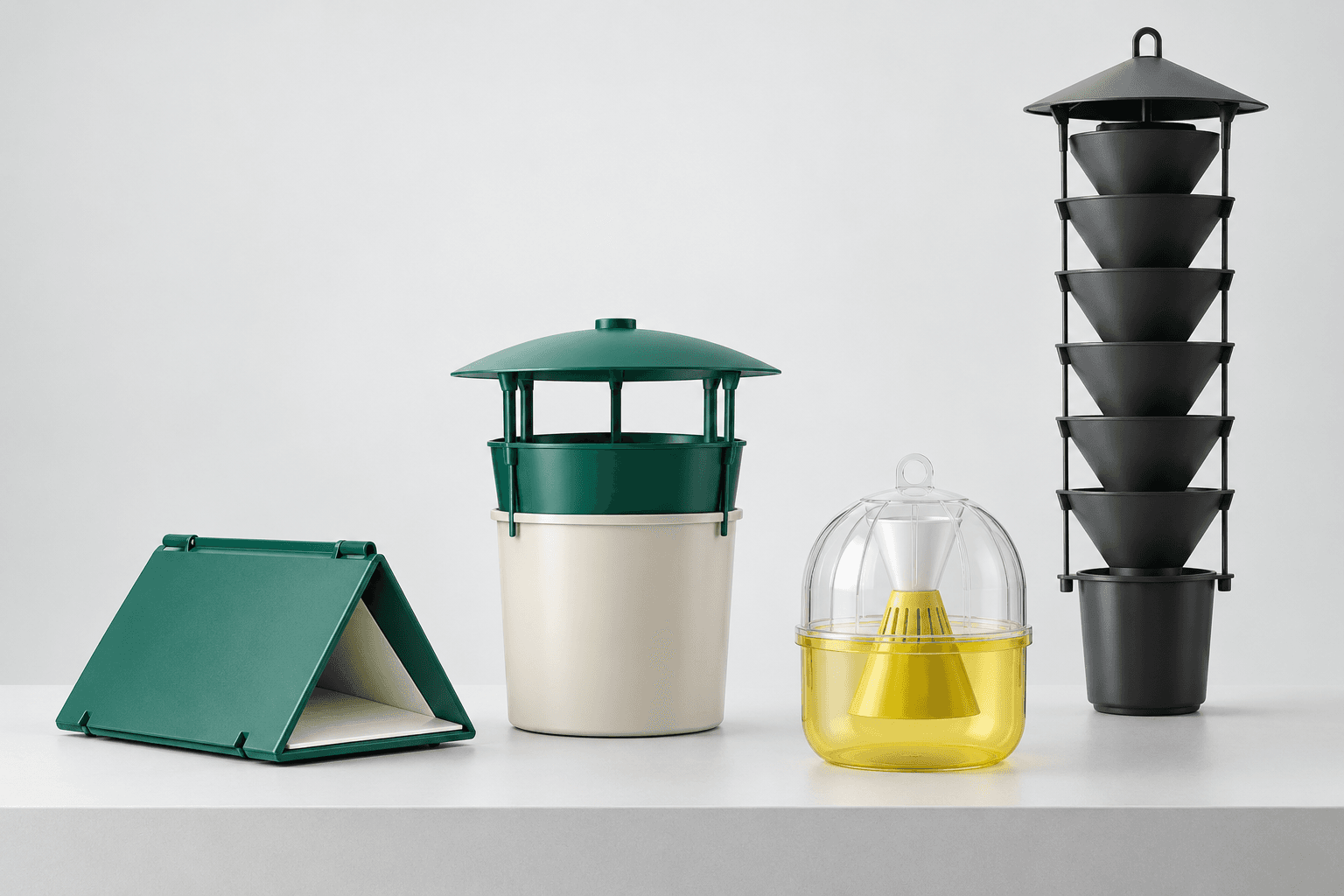
Original concept illustration · final configuration agreed with quotation
65
Trap configurations
10
Application families
One
Scientifically defined brief
A full development range, not a stock declaration. Select a configuration to discuss supply, samples or custom manufacture.
FIND YOUR CONFIGURATION
A trap for the
question you are asking.
Browse by insect group, environment or attraction method. Compare up to three designs before preparing your enquiry.
65 configurations
Original form studies · not to scale
Moth & orchardTS-002
Moth & orchardTS-003
Moth & orchardTS-004
Custom development
Universal funnel/bucket moth trap
Moth monitoring with a collection bucket
Species-specific lure
Moth & orchardTS-005
Moth & orchardTS-006
Moth & orchardTS-007
Moth & orchardTS-008
Moth & orchardTS-009
Custom development
Water-pan pheromone trap
Tomato leaf miner monitoring/trapping
Species-specific lure
Moth & orchardTS-010
Moth & orchardTS-011
Custom development
Navel-orangeworm egg monitor
Egg-laying activity surveillance
Oviposition-associated bait
Fruit & berry fliesTS-012
Showing 12 of 65
THE SCIENCE OF A USEFUL CATCH
Attraction is only
the beginning.
A lure, entrance and collector work as one system. Monitoring asks what is present and when. A pest-management programme asks whether an intervention changes crop outcomes. Those are different questions.
Discuss the semiochemical ↗- 01
Choose the cue.
Pheromone, host odour, food attractant, light, colour or natural movement.
- 02
Make entry and retention work.
Match flight or crawling behaviour to the entrance, surface and collection method.
- 03
Make the observation useful.
Agree counting, species identification, servicing and non-target assessment.
FROM REQUIREMENT TO REPEATABLE PRODUCTION
Your insect.
Your conditions.
Your trap configuration.
Specify housings, dispensers, adhesive inserts, collectors, packaging and connected observation. Begin with a brief; agree the prototype and evidence before a production commitment.
Explore custom manufacture ↗